How I Certified in Microsoft Fabric in 2 Months - Coming From Google Cloud

When I accepted the challenge of becoming Microsoft Fabric Practice Lead at Devoteam, I had 13 years of experience behind me - traditional SQL Server BI, Oracle Retail consulting, and six years deep in Google Cloud building data platforms with BigQuery, dbt, Airflow, and Looker. (not only, but mainly)
What I did not have was any meaningful Microsoft Fabric experience. I understood the ecosystem from a distance, had followed the announcements, and knew the architecture at a conceptual level. But knowing about something and being comfortable enough to lead a practice around it are two very different things.
My first decision was to certify. Not because certifications make you an expert (they don't!) but because going through a structured certification path is one of the fastest ways to understand how a new ecosystem thinks. The topics covered, the way questions are framed, the distinctions Microsoft considers important enough to test on - all of that tells you something about the platform's philosophy that reading blog posts and watching demos doesn't.
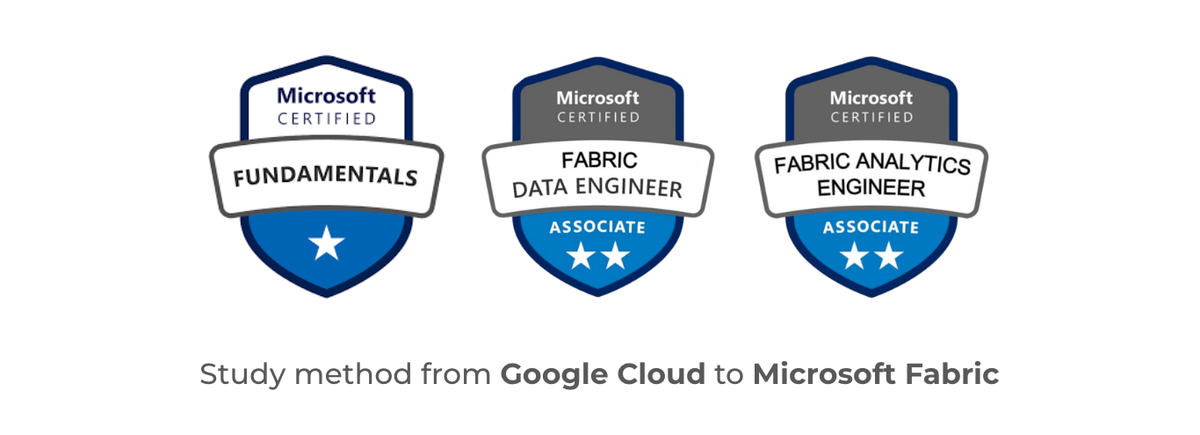
I completed three certifications in roughly two months. This post covers the path I took, why I chose that sequence, and the study method I use - the same one I have applied to every certification I've done, from Google Cloud to dbt to Terraform to Airflow..
Why sequence matters when switching ecosystems
Before getting into the certifications themselves, I want to explain the sequencing logic. Because this is the part that is specific to someone coming from another cloud ecosystem, and it is different from the advice you would give someone starting from scratch.
If you are already a data engineer, you do not need to study fundamentals the way a junior would. You already understand distributed systems, scalability, data governance, schema design, orchestration patterns. Those concepts are cloud-agnostic. What you do not know yet is how Microsoft implements them, what they call things, and where the philosophy differs from what you are used to.
So the goal of the first certification is not to learn data engineering. It is to map the Microsoft ecosystem onto what you already know, and identify the genuine gaps.
From there, you go specific. Once you understand the landscape, you certify in the areas most relevant to your actual work.
That is the logic behind the path I chose.
My study method - the same for every certification
Before walking through each cert, I want to share the approach I use consistently. I have applied this to Google Cloud certifications, dbt, Terraform, Airflow, and now Fabric. It is repeatable and it works.
Step 1 - Take a practice assessment on day one
Before reading a single page of documentation, I take a practice assessment. Not to pass it - I expect to fail at this stage. The goal is to understand the kind of questions they ask, the topics they focus on, and where my genuine gaps are. A first attempt at a practice assessment tells me more about what I need to study than the certification outline does.
Step 2 - Take notes organised by domain
As I go through the learning path, I take structured notes - not transcriptions, but my own interpretation of each concept. I organise them by feature or domain, not by the order the course presents them. This means when I need to review a specific topic before the exam, I can find it instantly.
Step 3 - Follow the full learning path with hands-on
I go through the official learning path cover to cover. Where there are hands-on exercises or sandbox labs, I do them. Where the topic connects to something I can try in my own playground, I try it. Reading without doing is significantly less effective for technical certifications - the questions test applied understanding, not just definitions.
Step 4 - Practice assessments until 3 consecutive passing scores
Once I finish the learning path, I move to practice assessments full-time. My rule: I do not book the exam until I have passed 3 consecutive practice assessments. If I fail one, the count resets. This rule forces me to have genuinely consistent knowledge rather than getting lucky on a good day.
Step 5 - Daily note review until exam day
After booking the exam, I keep reading through my notes every day until I sit it. Not intensive study.. just a 15-20 minute review to keep everything fresh in memory. The interval between booking and sitting the exam is usually a few days, not weeks.
The schedule
I study in early mornings before work and in evenings. Not every single day is equally productive, but the structure is consistent. For each of these three certifications I was putting in roughly 1-2 hours per day across that two-month period.
Certification 1 - Microsoft Certified: Azure Data Fundamentals (DP-900)
Why I started here
Coming from Google Cloud, my instinct was to go straight to Fabric certifications. But I resisted that instinct for a specific reason: I did not want to learn Fabric without first understanding where it sits in the broader Microsoft ecosystem.
Azure Data Fundamentals (DP-900) covers the foundational data concepts across the Azure platform, analytics workloads, and how services like Azure SQL, Cosmos DB, Synapse, and Fabric relate to each other. For someone completely new to Microsoft, this would be an introduction to cloud data concepts. For me, coming from four years on GCP, it was something else: a map.
Most of the content I already knew in principle. Distributed storage, data warehousing concepts, ETL vs ELT, the analytics stack.. none of that was new. What was new was the Microsoft naming and the Microsoft way of solving the same problems I had been solving on GCP. Synapse vs BigQuery. Cosmos DB vs Firestore. Azure Data Lake Storage vs Google Cloud Storage. Fabric vs the modern data stack I had been building.
Going through DP-900 let me build that translation layer before diving into Fabric-specific content. I knew where things lived, what they were called, and roughly how they related to what I already knew.
How I studied it
I used the official Microsoft Learn preparation path: Microsoft Certified: Azure Data Fundamentals
I did not go through every module at full depth - for someone with my background, some sections were quick reads to confirm I understood the Microsoft equivalent of something I already knew well. I slowed down specifically on anything Azure-specific that had no obvious GCP parallel, and on anything Fabric-related that appeared in the content.
Practice assessments on this one were relatively straightforward given my experience. I reached 3 consecutive passes faster than on the Fabric certifications and booked the exam shortly after.
What it gave me
A solid mental map of the Microsoft data ecosystem before I touched anything Fabric-specific. The time I invested here paid back in every subsequent certification.
Certification 2 - DP-700: Microsoft Fabric Data Engineer Associate
Why this was next
DP-700 is the data engineering certification for Fabric - pipelines, lakehouses, data warehouses, OneLake, ingestion patterns, orchestration. This is the closest to my daily work and the certification most directly relevant to the Practice Lead role.
After DP-900 gave me the ecosystem map, I went deep here. This one required genuine study. Not because the engineering concepts were unfamiliar, but because the Fabric-specific implementation details, the specific tools, and the way Microsoft thinks about data engineering are different enough from GCP that you cannot rely on existing knowledge alone.
How I studied it
Full Microsoft Learn preparation path, cover to cover: DP-700: Microsoft Fabric Data Engineer Associate
I used my personal playground a looot on this one. The Fabric-specific topics like building lakehouses, setting up Dataflow Gen2, working with Pipelines, configuring OneLake shortcuts, are the kind of things you need to actually touch to properly understand. Reading about how Direct Lake works is one thing. Seeing it behave in practice is another.
The practice assessments for DP-700 were a bit harder than DP-900, as expected. And I also tried some on Udemy. The questions go into implementation detail, not just "what is a lakehouse" but "in this specific scenario, which approach is the right one and why." That level of detail requires both study and hands-on experience.
I applied my 3-consecutive-passes rule here and it took longer to reach than on DP-900. A few topics required me to go back to my notes, and re-read specific Microsoft Learn modules before I was consistently passing.
What it gave me
Confidence in the Fabric data engineering layer - lakehouses, warehouses, ingestion patterns, Pipelines, orchestration. By the end I was not just aware of these things, I understood the trade-offs and could make decisions about when to use each one. That is the real value of a well-studied certification. Not the badge, but the decision-making confidence it builds.
Certification 3 - DP-600: Microsoft Fabric Analytics Engineer Associate
Why I completed the set
DP-600 covers the analytics engineering side of Fabric - semantic models, Power BI, DAX, Direct Lake, report design, data modelling for analytics. It completes the picture from the data engineering cert. DP-700 gets data into the lakehouse cleanly, DP-600 makes it consumable for business users.
I had two good reasons to take this one even though my background is more engineering than analytics:
First, as a Practice Lead I need to understand the full Fabric stack, not just the parts I personally build. When a client asks about semantic model design, Power BI governance, or Direct Lake vs Import mode trade-offs, I need to have informed answers.
Second, I wanted to understand where Fabric's approach to the analytics layer genuinely differs from what I was used to in Looker. The answer turned out to be: quite a lot. Power BI's semantic model with DAX is a different philosophy from LookML, and understanding that difference is useful both for advising clients and for writing about it credibly.
How I studied it
Same learning path approach: DP-600: Microsoft Fabric Analytics Engineer Associate
I spent more time on hands-on practice for this one than for DP-700. The engineering concepts in DP-700 translated more naturally from my GCP background. The analytics engineering concepts in DP-600: DAX, semantic model design patterns, Power BI-specific behaviours, were less familiar and required more deliberate practice.
My Looker/LookML experience actually helped in places: dimensional modelling, KPI standardisation, the idea of a single semantic layer as the source of truth for reporting, these principles carry across. But the implementation is different enough that I could not shortcut the study.
Two months in - what I actually got from this path
I want to be honest about what certifications do and do not give you.
What they give you: structured knowledge of the platform, confidence that you understand the core concepts, and a credential that signals to clients and colleagues that you have done the work. For someone switching ecosystems, they also give you a map. A way to understand how everything fits together before you start building in anger.
What they do not give you: real experience. The hands-on testing I did alongside the learning paths contributed more to my actual day-to-day competence than the certification study itself. The certification tells you what the options are. Experience tells you which option to reach for in a specific situation.
The combination of the two is what I would recommend. Certify to build the map. Build things in a playground to develop judgment.
My recommendation if you are making a similar switch
If you are coming from GCP, AWS, or a traditional BI background and moving into Fabric, here is the sequence I would suggest:
Start with DP-900 if you need the ecosystem map - especially if you are not yet comfortable with how Azure services relate to each other and where Fabric sits in that picture. If you already have a strong Microsoft/Azure background, you can probably skip this one.
DP-700 next if your work is primarily data engineering - pipelines, lakehouses, ingestion, orchestration. This is the most directly applicable certification for someone building data platforms on Fabric.
DP-600 after to complete your understanding of the analytics layer - especially if you work with clients who use Power BI, or if you need to advise on semantic model design, Direct Lake, or the reporting side of the stack.
The full path took me two months studying in the early mornings and evenings alongside a full-time job. That is achievable if you are consistent. The key is the 3-consecutive-passes rule and, unless you like pressure, do not book the exam until you are passing practice assessments consistently, not just occasionally.
You can apply this approach if you are moving to any other cloud provider. List the certifications that you should take, follow the learning path and get them done.
Useful links
- DP-900: Azure Data Fundamentals
- DP-700: Fabric Data Engineer Associate
- DP-600: Fabric Analytics Engineer Associate
The approach I described here is not specific to Microsoft Fabric or to someone coming from Google Cloud. If you are moving to any cloud ecosystem, the path is the same: identify the foundational certification that gives you the map, then go specific based on your role. Start with whatever the provider offers at the fundamentals level to understand how they think, then certify in the workloads you will actually build on. List the certifications you want, build your study plan around the learning paths the provider gives you for free, and get them done one at a time.
The two months I spent on these three Fabric certifications were some of the most productive of my career transition. Not because the badge matters, but because the structured study forced me to understand corners of the platform I would not have explored on my own for months. That head start paid off immediately in client conversations and in the hands-on work that followed.
If you are planning a similar switch and want to talk through which certifications to prioritise for your specific background and role, drop a comment below.
Carlos Martins - Microsoft Fabric Practice Lead at Devoteam Follow on LinkedIn - Subscribe to cloudingdata.ai